Finding the Past in Paper and Pixels

Decades of archives, burnout, and ditching online noise to pursue offline creativity, travel, and a slower, intentional life abroad.

While packing for our move, I dug through boxes that span back to high school—friend‑written stories, doodles, poetry, slang lists, and word‑play games. I also uncovered every college paper, notebook, and printed email chain from the late‑‘90s through the birth of my son and the completion of my first master’s degree, along with articles, notes, old résumés, and CVs. After the mid‑2000s, everything shifted to digital storage.

Looking at those old emails, sketches, and lists, I’m struck by two things: the passion and ambition that drove me, and the scatter‑shot nature of my attention. Many projects were left unfinished, books unread, ideas half‑formed.

In my thirties, when parenthood, a full‑time career, and a second graduate degree converged, burnout set in. Digital copies multiplied, but they came with no guarantees: hard drives failed, email providers changed with each job, platforms vanished, and search tools proved unreliable. Economic shifts forced priorities, and a lot of content slipped away, leaving some dreams deferred.

My forties were spent in tech, raising my son, paying off debt, and moving out of state. Burnout lingered, yet surrounded now by my late father’s notebooks, my own archives, and our library, I was reminded that there is more than enough to explore and immerse myself in—whether or not I pursued professional work for others. The abundance of material, both personal and inherited, offers endless possibilities, giving me a sense of purpose beyond employment.

That realization has also changed how I approach time. I’ve begun curbing the habit of “frittering” my hours online, endlessly consuming other people’s content. There’s a lingering belief that deep focus on reading, drawing, or studying makes me “unavailable” to my family—or that I’m merely “escaping” rather than being productive. That judgment feels almost Protestant‑era, reminiscent of the way Jane Austen’s characters are scrutinized for their choices.

For years, I equated online activity—social media posts, chats, data exchanges—with being “social” and “real.” I treated the digital realm as if it were as tangible as a café table or a sketchbook—its fleeting likes and comments offering instant, almost physical feedback, feeding my craving for connection and validation, even though all I was really producing was a paycheck for the platforms.

But it wasn’t just the lure of the screen; it was also the loss of a social ritual that had shaped my youth. After the turn of the millennium, cafés stopped feeling like true gathering places. Today, when I step into one, most people are glued to laptops or phones, each lost in their own online world.
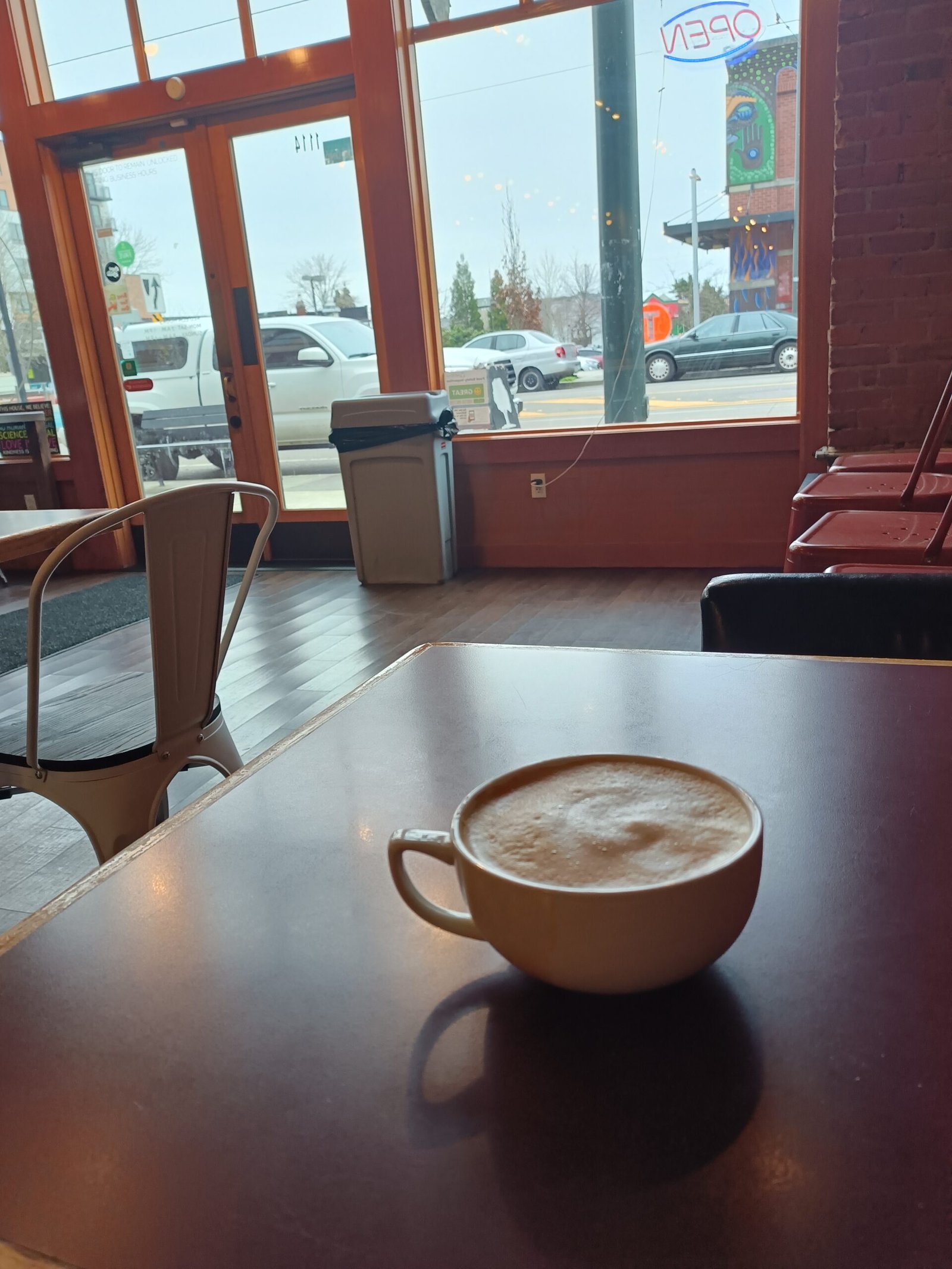
I miss the 1990s, when a trip to a café meant meeting friends, lingering over espresso, and talking for hours while the hum of the grinder provided a soundtrack. That café culture—the spontaneous conversation, the clink of cups, the shared silences—was a touchstone of my upbringing.

It’s exactly that experience I’m eager to rediscover when I move to Europe. My plan is simple: I’ll spend my days reading, writing, and making art in cafés. I’ll revisit my archives, travel, write about exhibitions and performances, and finally give those unfinished projects a chance to breathe. Surrounded by both my own work and the material I inherited, I know there will always be enough to keep me absorbed, on my own terms.

NOTES:

If you enjoy my writing here, you might also like some of my other projects:

  • 💡 I have a Patreon where I share extra writing, behind-the-scenes notes, and updates on creative projects. You can check it out here.
  • 📖 I recently self-published my MA thesis on Butoh, which is available here. If you’re curious about performance, embodiment, and cultural history, I’d love for you to read it.
  • 💸 Or, if you’d like to give a smaller one-time tip ($3), you can do so via Ko-fi [here]. Every bit of support helps and is greatly appreciated!

New photograph acquisitions at the Harry Ransom Center

The Harry Ransom Center is world renowned for its photography archives and their holdings are continuing to grow. From Feb. 9 until May 29, 2016 they will be celebrating almost 200 new acquisitions. Look Inside: New Photography Acquisitions traces progressions in the art from the post-war period through to the contemporary era.

Enjoy their time-lapse installation video here:

Tower Documentary – All Things Must Pass

Opening around the country is a documentary on Tower Records. For those of you that remember the 70’s, 80’s or 90’s, you will recall how Tower Records had hundreds of stores across the nation, in many other countries and was the place to go for videos, new LPs, singles, posters, music magazines and t-shirts.

For teenagers it was one of the few places that would hire you if you were a long-haired hippy, dressed punk, goth, or hip-hop. Tower saw you as a genre expert and if you worked hard, were detail-oriented and knew your stuff you could work up to becoming a music buyer and/or manager.  If you moved around, you could transfer easily to a Tower in your new town or get hired based on your experience.

It was a great gig. Didn’t pay a lot, but you would get promo CDs, tickets to concerts, get to listen to music on your shift and as long as you got your work done you could act as goofy as you wanted.

https://www.youtube.com/watch?v=xBfnQChA9XM

It was one of my favorite places to work as a late teen and early 20’s – I worked at the stores in Berkeley, Las Vegas and Austin, TX.  I kept trying to get a transfer to the Japan store but managers in Berkeley and Vegas kept sitting on my application.  My life would have been very different. Le sigh.

They are also raising money for Sacramento to have a museum, archive and perhaps even a traveling exhibit.

https://www.youtube.com/watch?v=-sj1J0cT5pc

It’s playing in Austin at the Regal Arbor (November 6th)
Release dates elsewhere can be found here:


Mexican Early Music from Colonial Archives

Discovered in the archives of Latin America was a treasure trove of Colonial works of art, sacred music for the feasts and holidays of the Catholic Church.  After Mexico defeated Spain these Colonial masterpieces from the 17th and 18th century were neglected for over a century but were rediscovered in the 1940’s.

The Austin Baroque Orchestra is holding their forth annual celebration of these musical archives, presenting works from three cathedrals from different regions, Oaxaca, the Hill Country of Northwestern Mexico and Mexico city.  From Oaxaca cathedral you’ll hear the works of Manuel de Sumaya, known as the “Mexican Handel.”  From Durango Cathedral in Mexico’s hill country you’ll enjoy Santiago Billoni, New Spain’s Italian-born maestro. From Mexico City’s Metropolitan Cathedral you’ll encounter the pieces by Ignacio Jerúsalem, Mateo Tollis de la Rocca, and Antonio Juanas.

A sample from last year’s selection of the works of Juan de Araujo can be listened to here. 

Find out more about these concerts here and here.

Saturday, November 14, 2015 – 8:00PM
First Presbyterian Church of Austin
8001 Mesa Drive · Austin, TX 78731

Sunday, November 15, 2015 – 4:00PM
Mission Concepción
807 Mission Road · San Antonio, TX 78210

Gabriel Garcia Marquez archive at the Harry Ransom Center

Please take the time to enjoy one of the Harry Ransom Centers most recent acquisitions, the Archive of Gabriel Garcia Marquez.

The HRC has issued a wonderful video giving an overview of this famous writer and his cultural contribution.

The director helps to explain the value of the Harry Ransom Center to our community, the university and the humanities field at large.  The Latin American studies director gives context to the weight of this collection.  One of its professors explains how the archive will be used by those in academia. The archivist discusses the collection and how the materials are being conserved and made available.

Gabriel Garcia Marquez archives now in Austin

One cannot mention the title source of the Strange Pilgrims exhibit without  reminding one’s readers that the Harry Ransom Center recently acquired the archives of Gabriel Garcia Marquez.

“More than 75 boxes of documents constitute the archive of the Colombian-born author, journalist, screenwriter and key figure in Latin American history and politics. Researchers will have access to manuscript drafts of published and unpublished works, correspondence, 43 photograph albums, 22 scrapbooks, research material, notebooks, newspaper clippings, screenplays and ephemera.”

Wed. Oct. 27 there will be a webcast of acclaimed author Salmon Rushdie’s keynote speech for the symposium Gabriel García Márquez: His Life and Legacy.