Finding the Past in Paper and Pixels

Decades of archives, burnout, and ditching online noise to pursue offline creativity, travel, and a slower, intentional life abroad.

While packing for our move, I dug through boxes that span back to high school—friend‑written stories, doodles, poetry, slang lists, and word‑play games. I also uncovered every college paper, notebook, and printed email chain from the late‑‘90s through the birth of my son and the completion of my first master’s degree, along with articles, notes, old résumés, and CVs. After the mid‑2000s, everything shifted to digital storage.

Looking at those old emails, sketches, and lists, I’m struck by two things: the passion and ambition that drove me, and the scatter‑shot nature of my attention. Many projects were left unfinished, books unread, ideas half‑formed.

In my thirties, when parenthood, a full‑time career, and a second graduate degree converged, burnout set in. Digital copies multiplied, but they came with no guarantees: hard drives failed, email providers changed with each job, platforms vanished, and search tools proved unreliable. Economic shifts forced priorities, and a lot of content slipped away, leaving some dreams deferred.

My forties were spent in tech, raising my son, paying off debt, and moving out of state. Burnout lingered, yet surrounded now by my late father’s notebooks, my own archives, and our library, I was reminded that there is more than enough to explore and immerse myself in—whether or not I pursued professional work for others. The abundance of material, both personal and inherited, offers endless possibilities, giving me a sense of purpose beyond employment.

That realization has also changed how I approach time. I’ve begun curbing the habit of “frittering” my hours online, endlessly consuming other people’s content. There’s a lingering belief that deep focus on reading, drawing, or studying makes me “unavailable” to my family—or that I’m merely “escaping” rather than being productive. That judgment feels almost Protestant‑era, reminiscent of the way Jane Austen’s characters are scrutinized for their choices.

For years, I equated online activity—social media posts, chats, data exchanges—with being “social” and “real.” I treated the digital realm as if it were as tangible as a café table or a sketchbook—its fleeting likes and comments offering instant, almost physical feedback, feeding my craving for connection and validation, even though all I was really producing was a paycheck for the platforms.

But it wasn’t just the lure of the screen; it was also the loss of a social ritual that had shaped my youth. After the turn of the millennium, cafés stopped feeling like true gathering places. Today, when I step into one, most people are glued to laptops or phones, each lost in their own online world.
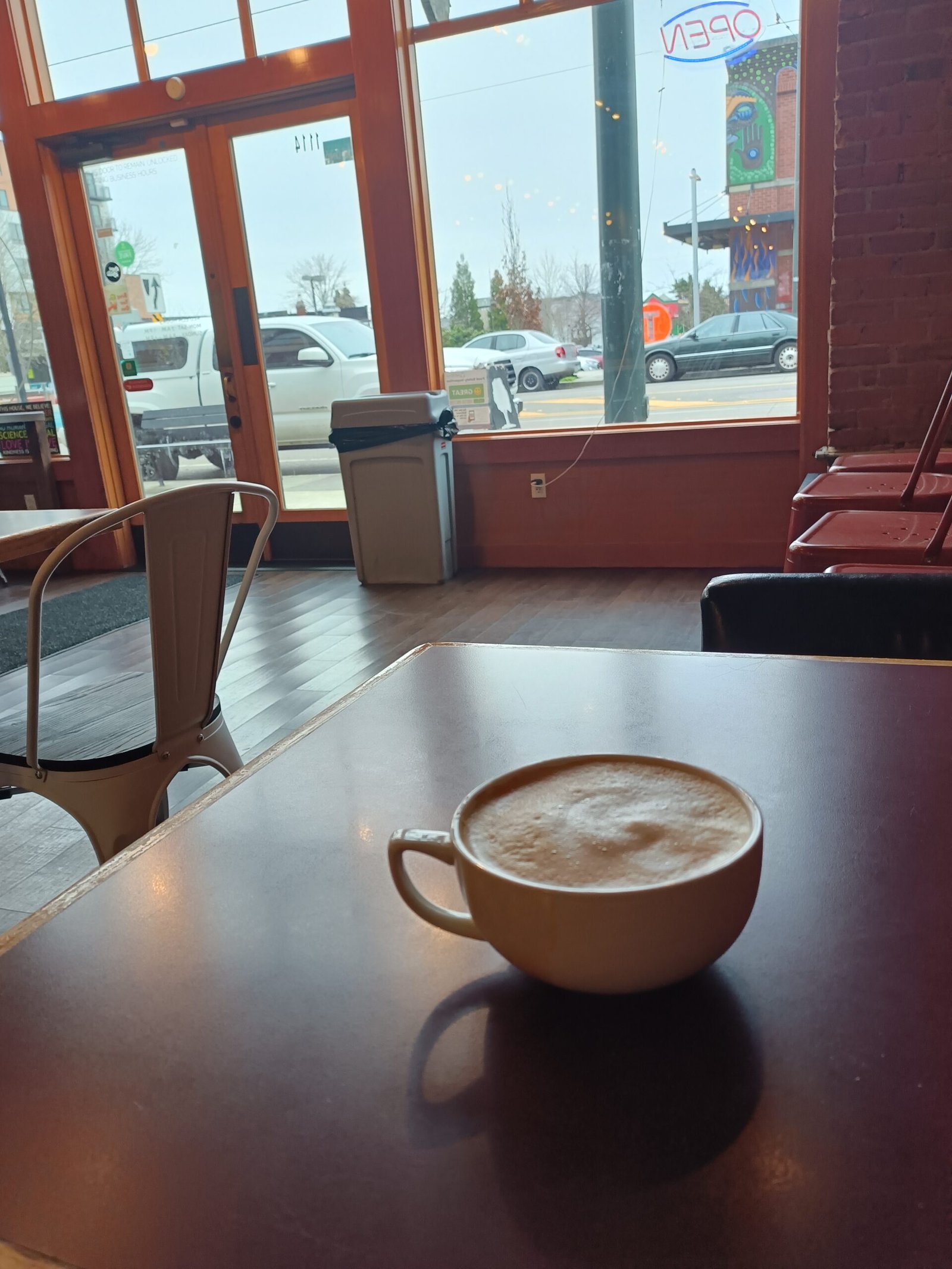
I miss the 1990s, when a trip to a café meant meeting friends, lingering over espresso, and talking for hours while the hum of the grinder provided a soundtrack. That café culture—the spontaneous conversation, the clink of cups, the shared silences—was a touchstone of my upbringing.

It’s exactly that experience I’m eager to rediscover when I move to Europe. My plan is simple: I’ll spend my days reading, writing, and making art in cafés. I’ll revisit my archives, travel, write about exhibitions and performances, and finally give those unfinished projects a chance to breathe. Surrounded by both my own work and the material I inherited, I know there will always be enough to keep me absorbed, on my own terms.

NOTES:

If you enjoy my writing here, you might also like some of my other projects:

  • 💡 I have a Patreon where I share extra writing, behind-the-scenes notes, and updates on creative projects. You can check it out here.
  • 📖 I recently self-published my MA thesis on Butoh, which is available here. If you’re curious about performance, embodiment, and cultural history, I’d love for you to read it.
  • 💸 Or, if you’d like to give a smaller one-time tip ($3), you can do so via Ko-fi [here]. Every bit of support helps and is greatly appreciated!

Gabriel Garcia Marquez archive at the Harry Ransom Center

Please take the time to enjoy one of the Harry Ransom Centers most recent acquisitions, the Archive of Gabriel Garcia Marquez.

The HRC has issued a wonderful video giving an overview of this famous writer and his cultural contribution.

The director helps to explain the value of the Harry Ransom Center to our community, the university and the humanities field at large.  The Latin American studies director gives context to the weight of this collection.  One of its professors explains how the archive will be used by those in academia. The archivist discusses the collection and how the materials are being conserved and made available.

Future of Gaming and Digital Scholarship

“The Most Dangerous Gamer”

“Never mind that they’re now among the most lucrative forms of entertainment in America, video games are juvenile, silly, and intellectually lazy. At least that’s what Jonathan Blow thinks. But the game industry’s harshest critic is also its most cerebral developer, a maverick bent on changing the way we think about games and storytelling. With his next release, The Witness, Blow may cement his legacy—or end his career. In a multibillion-dollar industry addicted to laser guns and carnivorous aliens, can true art finally flourish.”

http://www.theatlantic.com/magazine/archive/2012/05/the-most-dangerous-gamer/8928/?single_page=true

“I think the mainstream game industry is a &%$&-up den of mediocrity,” he told me. “There are some smart people wallowing in there, but the environment discourages creativity and strength and rigor, so what you get is mostly atrophy.”

Myself – I’m into museum studies, digital curation, digital archiving, physical archives….and to a lesser extent gaming. But I was once very hooked.  It’s the storytelling, participation and interaction, problem-solving, exploration, information organizing and collecting…all those drives are powerful not just for learning – but for collaborative learning and knowledge-production.

While there is a brilliant but lonely genius to the games of Jonathan Blow…there is something different at play with the studio – http://www.secondstory.com/ – something that connects to and inspires cognitive activity beyond solitary puzzle-solving…

When I think of what is stored in archival repositories like the Harry Ransom Center – and so many other museums – I think about the possibilities of bridging the power of interactive ‘gaming’ with the exploration of Art and Archives. When I recall powerful museum exhibits that transformed me… I think, what can be done to carry gaming further? I am certain that we are only at the beginning, the first steps of realizing what these techological ‘toys’ and digitization methods can ‘do’ for our creative records. We are in an age where there is a simultaneous need to preserve and to integrate knowledge so that we can solve so many of humanity’s problems. The evolution of gaming may hold the key.


Interactive Narratives for Digital Humanities Gaming

As I witness my 6 year old’s engagement in games like Zombie Farm, with its complex rules and scenarios, I reflect on the tremendous cultural holdings of libraries, museums and archives and wonder how can we engage the next generation in this material? How can we make learning using archives and collections something that can meaningfully compete with traditional gaming narratives stemming from fantasy, horror and science fiction? What are the constructive elements that take content that is scientific, relates to premodern folklore or modern day fears…and translates it to an engaging game?  For decades the gaming industry has rested upon the work done by the pioneers of table-top gaming (D&D, etc.) and arcade games.  In the meantime, educational interactive gaming has not caught up, reamaining trapped in tired metaphors of flash-cards and treasure hunts.

A number of creative and analytical things are on my mind right now….I am in the initially messy stage of compiling issues, factors, observations, possibilities and visions. I am spurred on first by the amazing work of Game Researcher Jane McGonigal who persevered through recovery from a brain injury by creating a game out of it…a game that could prove useful for anyone dealing with recovery (from quitting smoking to perhaps behavioral plans for children with special needs): http://blog.avantgame.com/2010/07/superbetter-ignite-talk-and-kickstarter.html

I am additionally moved by Ali Carr-Chellman’s TED talk about how to re-engage boys in learning through interactive gaming:
http://www.ted.com/talks/ali_carr_chellman_gaming_to_re_engage_boys_in_learning.html

It then occurs to me…the metaphors in video games are similar to sports, scouts and to martial arts. They are about ‘leveling up’ (belts, badges, etc.), having ‘allies’, defeating opponents, working with teams, engaging in strategic thinking.

The narrative archs as stated before deal primarily with mythos from European-folklore based fantasy, East Asian folklore, space operas and martial-arts based dramas, Lovecraftian horror, Vampire fiction, Zombie fiction and military scenarios.

Contemporary app. games are gradually deviating from these, but they still in part stem from the original objectives set up in the age of table-top gaming development: mystery-solving, puzzle-solving, collaborative problem-solving with teams.

These are all things that are not found in our school system or museum and archive exhibits.

How can we successfully carry these over to games involving content in historical or cultural archives? How can we make such games familiar in template, engaging and meaningful?

Lastly, because the following videos struck a cord in me that I have yet to completely process in terms of its relevance and application:  The following 4th grade male teacher in Japan uses team and literacy activities to develop social and emotional empathy among children: http://www.youtube.com/watch?v=armP8TfS9Is

Can we develop games that encourage use and understanding of the materials of cultural heritage while also developing social and emotional literacy? Can we do this through games and activities?

Lots to chew on.