Gabriel Garcia Marquez archive at the Harry Ransom Center

Please take the time to enjoy one of the Harry Ransom Centers most recent acquisitions, the Archive of Gabriel Garcia Marquez.

The HRC has issued a wonderful video giving an overview of this famous writer and his cultural contribution.

The director helps to explain the value of the Harry Ransom Center to our community, the university and the humanities field at large.  The Latin American studies director gives context to the weight of this collection.  One of its professors explains how the archive will be used by those in academia. The archivist discusses the collection and how the materials are being conserved and made available.

What’s in Dave Gahan, New Order & Gary Numan’s bag?

One of the things I miss most about living in Berkeley is going to record stores with my dad…going to Amoeba Music, or Tower Classics back in the day.  Having him teach me about Haydn
or Moondog, telling me his stories of having met Sonny Rollins or Miles Davis decades ago.

These stories and introductions to music helped to shape my tastes, which is why I am delighted with Amoeba Music’s video series ‘What’s in my bag?’ In the absence of programs like old MTV (120 minutes more appropriately), people turn to blogs like Pitchfork…but Amoeba is doing something rare and sorely needed by giving these artists video air-time to share the seminal albums that shaped them as well as the newer works they are impressed by.

[Disclaimer: This post contains affiliate links]

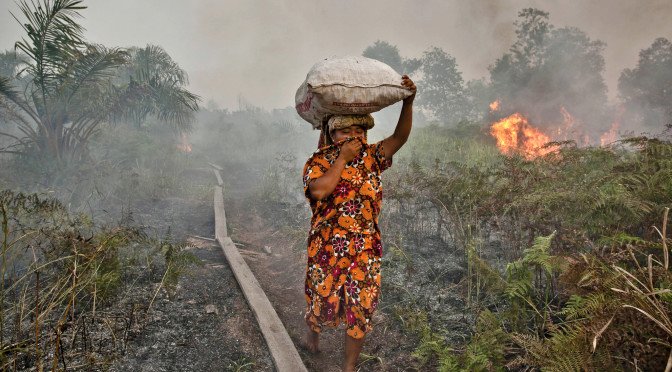
It’s Halloween and the Indonesia Rain Forest is on fire – what can I do?

George Monbiot alerts us that: “Indonesia is burning. So why is the world looking away?”

To give perspective on the devastation of this fire:

“it is currently producing more carbon dioxide than the US economy. And in three weeks the fires have released more CO2 than the annual emissions of Germany.”

For those of you who would like to have a Palm Oil-free Halloween, please refer to this list:


Laurie Anderson, Slavoj Zizek, Guillermo del Toro, Wim Wenders pick film faves from Criterion

One of the things I miss the most from my jobs in the 90’s – working in cafes next door to bookstores, working at the UC and Elmwood Theatres in Berkeley, working at Tower Records and Virgin stores in multiple cities – was how close I was to books, music, films.  Daily I would receive recommendations from co-workers and customers. I had a finger on a cultural pulse and it was three-dimensional and organic. This was an experience that Amazon and Netflix’s algorithms have not been able to replicate.

Something that Criterion Collection has started comes close and I really hope they continue. They’ve brought in famous film directors (Wim Wenders, Guillermo del Toro), artists (Laurie Anderson) and popular philosophers (Slavoj Zizek) to go through their vaults (Laurie Anderson is absolutely delightful, she’s like a kid in a candy store), select and describe their favorite films.

Their enthusiasm is contagious – I’ve done my best to compile a list of their recommendations under the clips. Enjoy!


Gabriel Garcia Marquez archives now in Austin

One cannot mention the title source of the Strange Pilgrims exhibit without  reminding one’s readers that the Harry Ransom Center recently acquired the archives of Gabriel Garcia Marquez.

“More than 75 boxes of documents constitute the archive of the Colombian-born author, journalist, screenwriter and key figure in Latin American history and politics. Researchers will have access to manuscript drafts of published and unpublished works, correspondence, 43 photograph albums, 22 scrapbooks, research material, notebooks, newspaper clippings, screenplays and ephemera.”

Wed. Oct. 27 there will be a webcast of acclaimed author Salmon Rushdie’s keynote speech for the symposium Gabriel García Márquez: His Life and Legacy.

Strange Pilgrims – Environment & Place

The Contemporary Austin is offering til January 24th of next year,  a surreal, experimental journey hosted in three parts, at the Jones Center, Laguna Gloria and the Visual Arts Center at UT.  Inspired in part by the title of the collection of short stories by Gabriel Garcia Marquez, these three showings feature “vignettes offering dark and surreal meditations on memory, mortality and the passage of time.” The following artists’ work is present in the exhibition:  Charles Atlas, Trisha Baga, Millie Chen, Phil Collins, Andy Coolquitt, Ayse Erkmen, Roger Hiorns, Nancy Holt, collective Lakes Were Rivers, Angelbert Metayer, Bruce Newman, Yoko Ono, Paul Sharits, and Sofia Taboas.  UT Press has published a 250 page catalogue of the exhibit.

The Jones Center is offering the first installment of the three-part exhibition, Environment and Place showcasing installation, video, architectural and landscape oriented works. 1960s-1970s conceptual and minimalist art by Bruce Nauman and Nancy Holt share space with contemporary artists Millie Chen, Andy Coolquitt, Roger Hiorns and Angelbert Metayer.

Bruce Nauman’s Green Light Corridor (1970) is about changing perspectives by inviting the viewing to walk through a narrow corridor lit by green neon lights. It’s presented within the large upper space of the downtown Jones Center, with its historical stone, wood and industrial walls. The juxtaposition of this piece with its neon to the cool, calm of the natural elements in the building is jarring.  I did not see many viewers volunteer to walk inside the corridor, perhaps because we are so often surrounded by neon and artificial light.  It would be interesting to compare audience perceptions from its original debut and environment 45 years ago.

Millie Chen’s Tour (2014) invites us to return to a different kind of temporal site.  In hers she presents four historical killing fields viewed while walking through tall grasses or meadows that have reclaimed the land. As we walk away from and through these sites of trauma we hear lullabies and gentle folk music from the Lakota, Khmer, from Rwanda and from Yiddish artists. Each site blends meditatively into the next allowing us to take this tour and reflect.

Radical Transformation – Magnum Photos at the Harry Ransom Center

Heraclitus tells us that you cannot step in the same river twice, because it’s not the same river and you’re not the same person…but this is precisely what great art and photography can accomplish. In the largest donation made to the Harry Ransom Center, two thousand Magnum prints have inspired a selection of dramatic, frozen instances from our cultural memory of the 20th century.

Read more…

Museum reviews on Examiner.com

I’ve been busy the past two years as a digital librarian for a semiconductor company, but I’m trying to dip my toe back into art criticism. What follows are a sampling of earlier reviews.

“The sculpted bust of two young black girls byJohn Ahearn, playfully whispering into each others ear is full of humanity and joy. Unlike the mimetic idealism we see so often in historical portraits of children, Ahearn captures fleeting emotional subtleties in his realism that we know exist and that are usually lost only to memory.”

“It’s difficult to tell what is more fascinating about the exhibit, the marvelous cross-section of New York contemporary art or this generous and devoted couple….They were a couple that built relationships with artists, asking and valuing their opinions. Quotes from these artists about this couple can be found throughout the exhibit, praising their pure and authentic eye as well as their practicality.

“After years of violence and oppression through the 1970’s to early 1980’s, the art from the 1990’s show a society in transformation, re-evaluating identity, positions and expression.”

Future of Gaming and Digital Scholarship

“The Most Dangerous Gamer”

“Never mind that they’re now among the most lucrative forms of entertainment in America, video games are juvenile, silly, and intellectually lazy. At least that’s what Jonathan Blow thinks. But the game industry’s harshest critic is also its most cerebral developer, a maverick bent on changing the way we think about games and storytelling. With his next release, The Witness, Blow may cement his legacy—or end his career. In a multibillion-dollar industry addicted to laser guns and carnivorous aliens, can true art finally flourish.”

http://www.theatlantic.com/magazine/archive/2012/05/the-most-dangerous-gamer/8928/?single_page=true

“I think the mainstream game industry is a &%$&-up den of mediocrity,” he told me. “There are some smart people wallowing in there, but the environment discourages creativity and strength and rigor, so what you get is mostly atrophy.”

Myself – I’m into museum studies, digital curation, digital archiving, physical archives….and to a lesser extent gaming. But I was once very hooked.  It’s the storytelling, participation and interaction, problem-solving, exploration, information organizing and collecting…all those drives are powerful not just for learning – but for collaborative learning and knowledge-production.

While there is a brilliant but lonely genius to the games of Jonathan Blow…there is something different at play with the studio – http://www.secondstory.com/ – something that connects to and inspires cognitive activity beyond solitary puzzle-solving…

When I think of what is stored in archival repositories like the Harry Ransom Center – and so many other museums – I think about the possibilities of bridging the power of interactive ‘gaming’ with the exploration of Art and Archives. When I recall powerful museum exhibits that transformed me… I think, what can be done to carry gaming further? I am certain that we are only at the beginning, the first steps of realizing what these techological ‘toys’ and digitization methods can ‘do’ for our creative records. We are in an age where there is a simultaneous need to preserve and to integrate knowledge so that we can solve so many of humanity’s problems. The evolution of gaming may hold the key.


Re-configuring Progress and Development in the age of Sustainability Needs

Considering how lifestyles in the “developed” West consume the greatest amount of resources and have tended toward wasteful practices, what are non-Western lifestyle habits that we in the West could adopt? We may need to change our ways as populations grow, migrate due to climate change and resource restrictions.  One thing that we’re doing is growing more vegetables, herbs, chilis and peppers, getting beans, spices and lentils in bulk, especially from the local Indian grocery. We are learning to make Indian, Middle-Eastern and Asian dishes in low-energy ways (crockpot) and would like to learn how to create a solar oven as we live in a very hot climate with lots of sun exposure.  We are drying clothes outside, catching rainwater for the garden, not watering our lawn, drinking more teas and iced teas and running indoor fans.  I would like to see more telecommuting and working earlier and later, with staggered siesta times to conserve energy for people to rest.  People would be healthier, happier and there would be less carbon spent during the higher temperature times of the day.

We need a way to reframe the notion of “development’ or ‘progress’ so that it is not immediately equated with increased resource consumption and carbon creation.  There needs to be a way to reframe a move back to practices of the “less-developed” world in ways that are not negative or patronizing. We need to rethink the 20th century industrial/colonial linear paradigm that has this world on a crash course. How can we describe a move toward sustainability, conservation, investment in renewable resources and energy in ways that are practical, positive and possible?  Some may observe that the “developing” world is already leading on this topic…How then can we in the “developed” West release our grasp on wasteful practices and learn from the rest of the world?  This concerns how we structure our work-day, how we build our homes, or how we manage the water we use (can we begin to implement home-irrigation methods using a natural-filtered process to use grey-water from laundry machines, showers and dishwashers? – something that would be especially useful where homes would like to grow their own vegetables and fruit trees).

In as much as the 21st century seems to be shaping up to be an Asian century, I believe it would be good to revisit the work of early 20th century Indian, Chinese and Japanese intellectuals who debated traditional Asian values vs. the goals of colonial modernity in the pre-World War period.  Scholars like Okakura Kakuzo and Rabindranath Tagore.

And I am of course also looking to practices in pre-Colonial “Latin” America and Africa as we are discovering that colonial practices destroyed the sustainability these populations had achieved over thousands of years and lead to current states of poverty.  I’m considering lifestyle, permacultural and social practices that fostered greater communities and well-being.  Examples of efforts to heal these communities can be seen in the following resources (for Africa and South Asia):  A Thousand Suns,  a permaculturalist on “Greening the Desert”Barefoot College,  and the work of Narayana Krishnan.

What are other theories, examples and practices that could offer those in the West a way toward a greater “progress” or “civilization” in how Gandhi might have understood it?  As the rest of the world “advances” and the climate and resources of the world change radically and constrict, how can we all adapt in ways that are positive and sustainable? What about the stories we’ve been telling ourselves, need to change? How do we need to re-define “leadership?” How do we need to re-consider “development?”